On 13 November 2025, the Continuous Cover Forestry Group of Hungarian Forestry Association organized a field training course entitled “Experiences with gaps created with different sizes, shapes and dynamics in a hornbeam–sessile oak forest”.
The Pilis Gap Experiment, launched in 2018 to examine the gap-creation concept that emerged at Pilis Park Forestry Company (PPFC), deals with the effects of gaps of different sizes and shapes applied in continuous cover forest management. The aim of the training was to demonstrate how different gap shapes and sizes, aspect, and the characteristics of the surrounding stand influence the development of sessile oak within the gaps. Research results from recent years have greatly contributed to the successful creation of oak gaps. In addition, participants became familiar with the practical knowledge of creating gaps when tending sessile oak within gaps, and how an appropriate amount and ratio of direct and diffuse light can be ensured. During the demonstration, they were introduced to various field instruments, mobile phone applications, and forestry tools that support the specialized tending of gaps, and their use was also demonstrated.
The thematic outline of the training was as follows:
Theory:
- General introduction to the continuous cover management system. Within this, the role of gaps.
- Presentation of experience gained so far after the creation of gaps
- Presentation of the research – different gap types, size and dynamics
- Changes in light and soil moisture in the gap during the first five years
- Development of the understory vegetation during the first five years
- Regeneration in the different gap types
- Conclusions for practice
Practice:
- The need for, extent and technology of treating and tending gaps (Péter Csépányi, Attila Csór)
- Surveying new gaps
- Tending existing gaps
- Widening gaps
- Tools required for gap treatment
- Completing the test
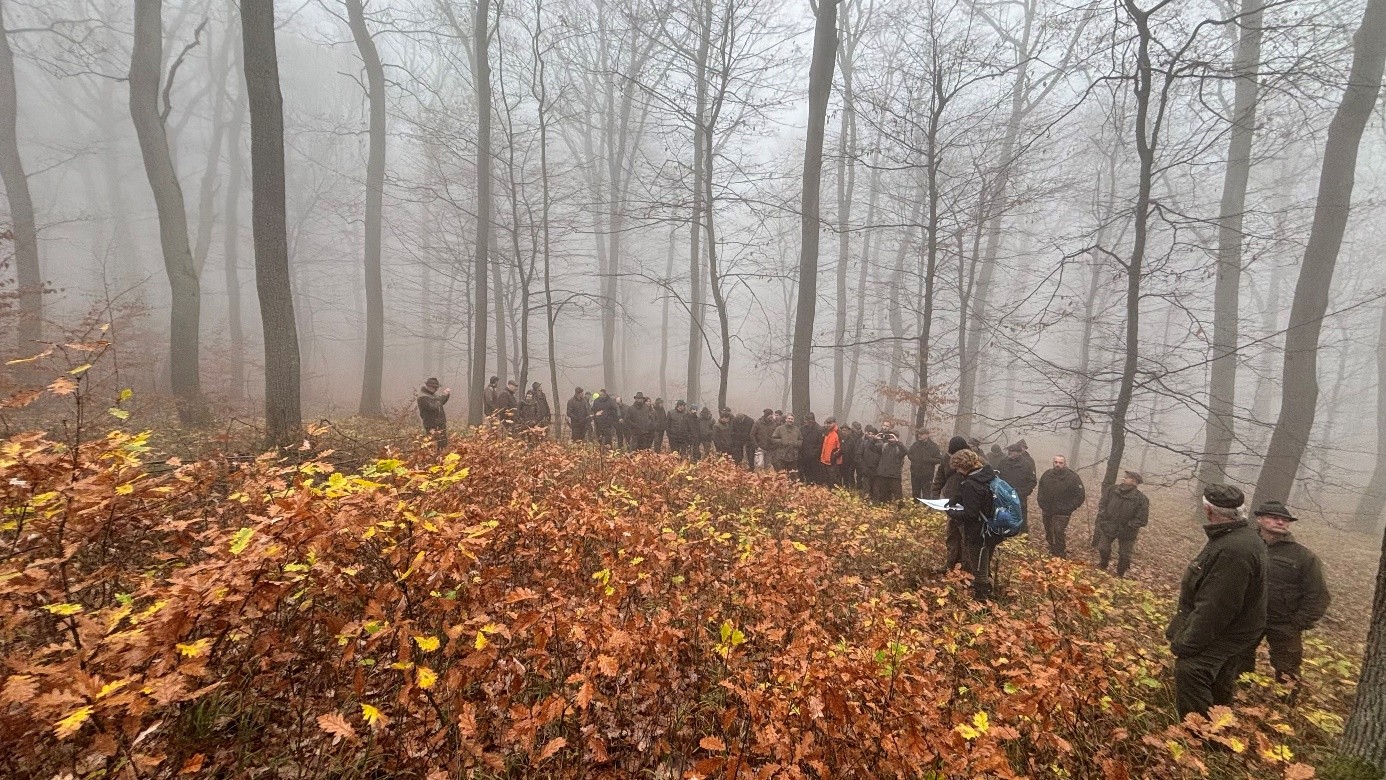
Participants of the training in the Pilis Gap Experiment, led by ecologists Flóra Tinya and Péter Ódor. (photo: Péter Csépányi)

Participants of the training listening to Attila Csór’s presentation (photo: Péter Csépányi)

Péter Csépányi demonstrates the use of the sun compass (photo: Attila Csór)