As climate change intensifies, one of the key challenges facing forestry is how to balance efficient timber production with the preservation of forests’ climate-regulating functions, biodiversity and resilience. The growing public demand for recreation in forests, together with increasing opposition to clear-cutting, is also driving the search for more sustainable management approaches.
News
Elongated canopy gaps may best support the natural regeneration of oak forests
2026.06.01. – HUN-REN Centre for Ecological Research
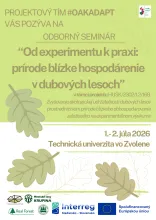
Workshop: „Od experimentu k praxi: prírode blízke hospodárenie v dubových lesoch“
2026.05.12 – Technical University in ZvolenThe Slovak project team of OakAdapt is preparing workshop at July 2026 focused on close-to-nature forestry of oak forests and on the application of experimental research findings to forestry practice. The event is intended for Slovak stakeholders from forestry, nature conservation, research institutions, local authorities, and related sectors.
The workshop will include both lectures and a field excursions. Further information about the programme and organization of the event can be found in the attached invitation.
The first year of the Interreg HUSK #oakadapt project from the perspective of TUZVO
2026.01.31. – Technical University in ZvolenWithin the Interreg HUSK #oakadapt project, the Technical University in Zvolen is involved in research, coordination, and promotion activities focused on enhancing the adaptability of oak forests through close-to-nature forest management.
Field training on oak canopy gaps for practicing foresters
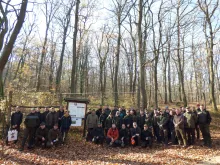
2025.11.13. – Pilis Park Forestry Company, Pilisszentkereszt DivisionOn 13 November 2025, the Continuous Cover Forestry Group of Hungarian Forestry Association organized a field training course entitled “Experiences with gaps created with different sizes, shapes and dynamics in a hornbeam–sessile oak forest”.
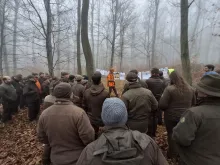
Consultation between Slovak stakeholders and project partners in Hungary
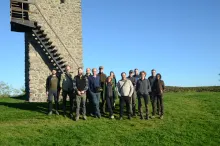
2025.11.06. - 2025.11.07. – Štúrovo/Slovakia, Pilis Mountains/HungaryOn November 6th and 7th, a large team of 45 forestry experts from Slovakia, who were invited by the Slovak project partners and were interested in oak management under continuous cover forestry (CCF), met with the representatives of the Hungarian partners.
International conference in Würzburg
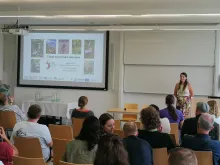
2025.09.01. – Würzburg, GermanyCsenge Veronika Horváth participated in the annual meeting of The Ecological Society of Germany, Austria and Switzerland (GfÖ), held in Würzburg, Germany on the first week of September. At the international conference, Csenge presented the results of her manuscript under preparation, which investigates the fine-scale patterns of herb layer compositional response to different management interventions of the Pilis Forestry Systems Experiment.
International conference in Baku
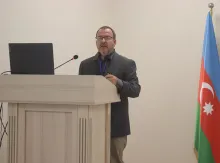
2025.06.18. - 2025.06.19. – Baku, AzerbaijanPéter Ódor participated in a conference in Baku, organized by the Institute of Botany of the Azerbaijan National Academy of Sciences. On the first day, Péter gave a presentation on the experiments related to the project. On the upcoming day, he held a two hour workshop on the possibilities of sustainable forest management, discussing the results of the project.
Project kick-off meeting
2024.10.24 - 2024.10.25. – Slovakia and HungaryThe project kick-off meeting was held by the partners on 24-25.10.2024 in Slovakia and Hungary.